
Case Studies in Building Science: revamping CIV1282, a favourite among alum

After several years in hiatus, CIV1282 – Case Studies in Building Science is being relaunched. Professor Alex Lukachko, of Daniels Architecture, is taking on the challenge of delivering this essential course with a rich variety of new real-world case studies.
The goal of the course is to have students advance their building science skills by examining performance issues in real buildings and then develop holistic solutions which include considerations related to climate change and the energy transition.

The revamp is under the guidance of CivMin Professor Marianne Touchie, who notes its long history and pivotal place within the curriculum. “I remember taking it back in grad school,” recalls Touchie, “and found it was a wonderful way to connect building science theory to practice and develop forensic engineering analysis skills to get to the root cause of building performance issues. Many of the alumni on our building science industry advisory panel also shared their fond memories of the course and expressed how pivotal it was in their building science education.”
Emphasizing the thorough modernization of the content, Touchie adds, “I’m really excited to see this course revamped and relaunched for the next generation of building science students, particularly with Alex at the helm. He is the perfect fit for this course, bringing his wealth of project experience into the classroom for our students.”
CivMin spoke with Prof. Lukachko to learn more about what’s new with CIV1282 – Case Studies in Building Science.
Alex, please tell us about this new course. What’s going on with CIV1282?
This is not actually a new course. The Case Studies in Building Science course was offered in the department for years, but not for the last five or six years. This was an amazing course dealing with bringing building science problems together with real-world solutions. And for students in the fourth-year civil engineering, that were taking a building science specialty, this was an opportunity to test out skills they learned throughout the program. Especially on problems found in the construction industry, taught by some pretty amazing U of T professors, many who are now retired – the course is sort of famous in the industry.
The industry advisory group for the faculty, and outside of the university, asked to bring this course back. They felt students could take it, and be better prepared for practice, but also, potentially, practitioners could come back to the university and sit in on this case studies course. It’s essentially a reboot of what was a pretty special course in the U of T program.
Who should take this? Who should be rushing to sign up for this course?
I think anyone who’s entering the building industry and interested in solving problems that contemporary practice faces related to the performance of buildings. They should be taking this course because the way it’s positioned allows students to take the fundamentals they’ve learned earlier in their program and apply them directly to these problems.
We would love to hear some examples. Can you tell us a bit more?
Basically, the course will use a set of case studies that are representative of problems we’re currently facing in the industry. As an example, the building industry is now building lots of mass timber buildings. We’re trying to reduce the amount of embodied carbon by using materials that have much lower environmental impact.
Mass timber buildings are relatively new on a large scale. Anything that’s new we tend to get problems or challenges coming up we didn’t have when we were building conventional construction. There are questions about mass timber buildings, such as can they be assembled on site, so they don’t get wet, there’s not mold, there’s not decay, that they’re as safe during operation as conventional buildings are and so on. From a design perspective, we know how to put these all together, but there are challenges that happen on the construction site that we really need to understand as well. And so, there are opportunities out there. In one of the case studies, we’ll be looking at a real-world example of a mass timber building under construction in the worst possible situation in terms of rain and climate.
There are all kinds of critical issues for mass timber construction that we just didn’t have in the building industry even 10 or 15 years ago. We’re going to hear from all the stakeholders in the project, to set up what the problem is, and then we’re going to take a deep dive into the technical analysis of the problem and create recommendations. That’s what the students will be working on, and those recommendations are then going to be vetted by people familiar with the project. This will be real-life feedback for the students from people actually involved in the project who can explain what needed to happen and what happened.
In essence, the students will gain an appreciation for not only how to apply their technical skills, but about the context for these problems. For instance, understanding what the needs and requirements of other people on the project are, including the owners, the building code officials, the structural engineers on the project – all the different perspectives. Then, learning how to report back recommendations that come out of the analysis work they’ve been trained to do in a way that can make decisions easier, and more confidently, for the clients. It’s really about how to do consulting where we have critical issues that the industry hasn’t faced in the past.
Glancing at your LinkedIn, you have an impressive background. Can you tell us a little bit about this, how you draw from it and bring your experience to the classroom? What can [students] expect from you?
Absolutely. I’m trained as an architect, and I’ve worked for 20-plus years in the building science industry – I’m a building science and sustainability consultant.
I’ve worked for several building science firms and done consulting work across North America on all different building types. In addition to that, I teach at the Daniels Faculty of Architecture, where I teach building science and sustainability. I bring quite a bit of experience as a consultant, particularly with buildings that are looking to be more sustainable than conventional construction.
This course is setting up case studies that are kind of deeply embedded in this context of the of the building industry, contemporary practice right now. And thinking about how to address the climate crisis, how to deal with new materials, how to address new challenges as they come up. That’s the kind of real-world experience and connection that I’ll bring to this course.
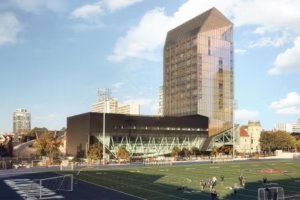
What buildings or structures, especially if you can use the examples, might inspire you the most to point out and get excited about?
I would pick out a couple of buildings right here on the U of T campus that I think are fantastic. There’s the Academic Wood Tower being built on top of the Goldring Centre – an amazing addition to a contemporary building. This is a mass timber construction that has all sorts of things that are new. It’s a high level of design, first of all, but it’s also a high level of performance.
This building is incredibly thermally efficient. It uses new building enclosure systems to wrap a mass timber structure, which in itself is a pretty novel thing in our industry right now. And it’s the technical challenges in making that work that are really fascinating, but it’s representative of the type of building we’re going to need many, many more of.
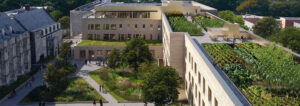 And, right across the street at Trinity College, the Lawson Centre for Sustainability, is another mass timber building. This one is a residence, not an academic building, but it does have some academic functions in it. It is representative of the kind of buildings we’re going to be building in the future, but so different than things we’ve done even 10 years ago.
They’re both fantastic architectural examples, but more fascinating because the way these buildings are meant to perform for their occupants, and also environmentally, is light years ahead of most contemporary practice. They’re fascinating examples. I like those too, because all of the students at U of T have access to see these structures as they’re being built and can really learn a lot about them. There’s two examples of what I think are some pretty special buildings, and we’re going to see more of these in the future.
Do you have a hidden talent, or special skill, that would be interesting for us to learn about?
I’ve maybe two things I could mention – I run long distance and I’m also an axe thrower. I’m one of the top 100 axe throwers in the International Axe Throwing Federation.
By Phill Snel